
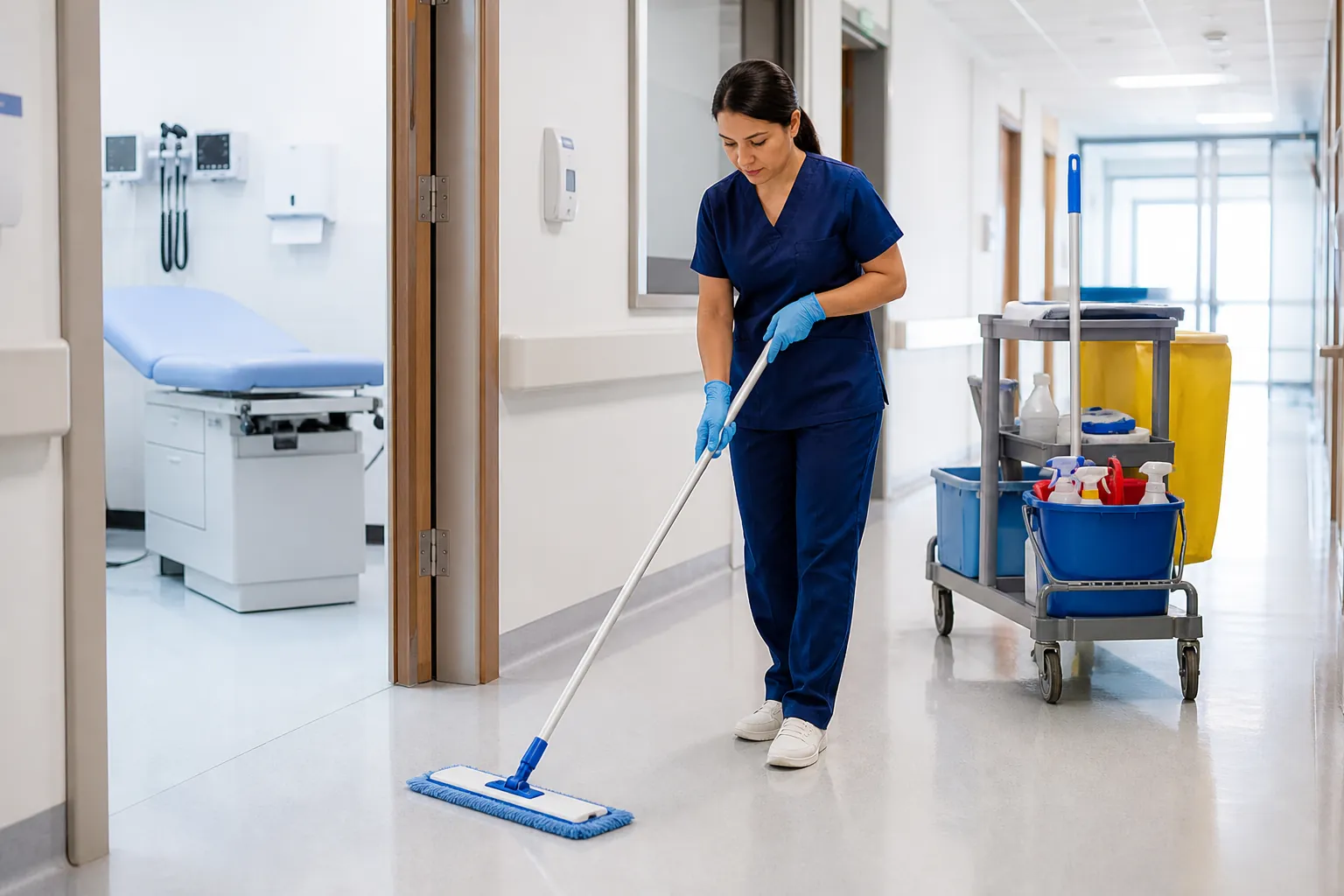
Three principles hold the whole program together: work from clean areas toward contaminated ones, keep microfiber and mop heads separated by zone, and respect the labeled wet contact time of every disinfectant. A surface wiped dry too quickly has been cleaned, not disinfected.
Waiting Room & Reception
Recommended frequency: Every service visit
- Disinfect check-in counters, payment terminals, pens, clipboards and sign-in tablets.
- Wipe chair arms, side tables, door handles, push plates and light switches.
- Vacuum carpet and detail-mop hard floors, including edges and under seating.
- Empty waste receptacles and replace liners; sanitize touchless dispenser fronts.
- Clean glass partitions and entry glass to remove hand contact marks.
Exam & Treatment Rooms
Recommended frequency: Daily or between sessions
- Disinfect exam tables, stools, tray tables, cabinet pulls and counter surfaces.
- Wipe blood pressure cuffs housings, equipment carts and mounted monitor bezels.
- Detail sinks, faucets, soap and glove dispensers; restock consumables.
- Mop hard floors with a hospital-grade disinfectant and fresh solution per room group.
- Remove and stage regulated waste containers per the practice's written procedure.
Restrooms
Recommended frequency: Every service visit
- Disinfect toilets, urinals, flush valves, seats, partitions and grab bars.
- Clean and polish sinks, faucets, mirrors and counter surfaces.
- Scrub floors with attention to grout lines, corners and behind fixtures.
- Restock tissue, seat covers, hand towels and soap; check dispenser function.
- Deodorize drains and confirm no standing water or leaks are present.
Lab, Sterilization & Utility Areas
Recommended frequency: Daily, with defined boundaries
- Clean floors, exterior cabinet faces, sink basins and non-clinical counter areas.
- Leave clinical instruments, sterilizers and specimen areas to trained clinical staff.
- Confirm sharps and biohazard container placement without handling contents.
- Wipe door hardware, light switches and refrigerator handles.
Staff Areas, Offices & Break Rooms
Recommended frequency: Daily to weekly
- Disinfect shared desks, phones, keyboards trays, copier panels and cabinet handles.
- Clean microwave exteriors, refrigerator handles, sinks and counters.
- Empty waste and recycling; sanitize bin rims and lids.
- Vacuum and mop floors, including under tables and along baseboards.
Periodic & Quarterly Work
Recommended frequency: Monthly to quarterly
- High dusting of vents, sprinkler heads, light fixtures and exit signage.
- Carpet hot-water extraction in waiting areas and corridors.
- Hard-floor machine scrubbing, plus strip-and-finish cycles where applicable.
- Detail cleaning of baseboards, door frames, chair rails and wall touch points.
- Interior glass and partition cleaning throughout the practice.
Documentation Your Practice Should Expect
Accountability that survives a staff change
- A written scope of work listing tasks by zone and frequency.
- Product safety data sheets for every chemical used on site.
- A certificate of insurance with general liability and workers' compensation.
- Background-check confirmation for every technician entering the practice.
- A named supervisor, inspection cadence and a single channel for reporting issues.
Practices that also need periodic restoration typically pair daily service with commercial deep cleaning and tile and grout cleaning on a quarterly cycle.
Frequently Asked Questions
- What is required in a medical office cleaning program?
- A medical office program needs documented disinfectant products with appropriate contact times, color-coded microfiber to prevent cross-contamination between zones, correct sequencing from clean to dirty areas, defined boundaries around clinical equipment and regulated waste, and trained staff who follow bloodborne pathogen and PPE practices.
- How often should a medical office be professionally cleaned?
- Most clinics in the Tampa Bay area are cleaned every business day, because exam rooms, restrooms and waiting areas accumulate high-touch contamination quickly. Higher-volume practices often add day-porter coverage plus periodic floor care and high dusting.
- Do cleaning crews handle biohazard or sharps waste?
- No. Janitorial teams should stage and support regulated waste handling without opening or transferring contents. Sharps and biohazard material remain the responsibility of trained clinical staff and the practice's licensed medical waste vendor.
- What is the difference between cleaning, sanitizing and disinfecting?
- Cleaning removes soil and organic matter from a surface. Sanitizing reduces microorganisms to a safer level. Disinfecting uses an EPA-registered product held at the labeled wet contact time to kill specified pathogens — which is why dwell time matters as much as the product itself.
Build a Clinic Program Around Your Patient Schedule
We service medical and dental practices across Clearwater, Largo, St. Petersburg and Tampa, working after hours so exam rooms are ready before the first appointment.
Schedule your walkthrough